Mobile Journalism (MOJO)

This week in class we talked about Mobile Journalism otherwise known as MOJO. There are many trends within MOJO that we should be aware of. The first is how high the demand for video is. This is because everyone now days is glued to their phones. People are now staying up to date on news via phone rather than watching it on TV. Another trend is the growth of social media. If your audience is on social media, they you too need to be on social media in order to stay interacted with them. Having quick and easy access to stream and post video content through your mobile device is a huge plus of MOJO. With that being said, it is easy to create content on the same platform that it is being viewed. Before today, the way we would stream media was through TV, radio, and books. Now days, content is multi-media and the key ingredient is your smartphone. Your smartphone can take pictures, record audio and video as well as editing graphics. These are all examples of mixed media content all through one device being your smartphone. Another trend is live streaming. Live stream is a trend that you are able to do within multiple different social media platforms, like Facebook live.
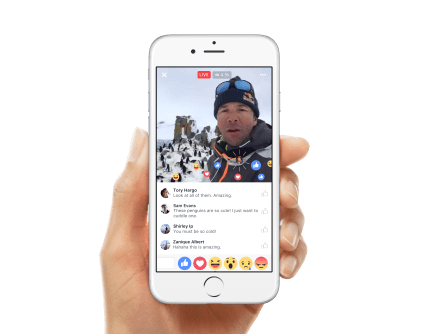
A facebook live video streaming from an iPhone.

Even major broadcasters are using livestream from their mobile phones.

One of the first live broadcasts through a phone.

Overall, mobile journalism is cost-effective, powerful, and in tune with the trends. When it comes to cooking, mobile journalism an easy way to help others when it comes to cooking. For example, all over YouTube there are cooking videos that allow others to learn different recipes by simply watching a video.

Example of a YouTube cooking video

Watching a video is a much easier way to learn how to cook rather than reading the recipe out of a cook book.
Guest Speaker Post

This week in class, we had the pleasure of having Alberto Linares come and speak to our class about Augmented Reality and Virtual Reality, and his experience working with them. One of the main things that Alberto is passionate about is music, and specializes in drums and guitar. He has had the opportunity to work with many famous musicians for example he mentioned that he got to work on a project for a band called Mumford and Sons. Since Albert spoke about how he has used AR within the music industry, I wanted to focus on how AR can change the music industry completely.  Harris study says that 78% percent of millennials would rather put money into experiences and events over a desirable object, and another 72% say they want to increase the amount they put towards experiences over physical objects in the coming year. Audiences are already familiarized with the technology, and the most popular, mainstream examples of AR would be Pokemon Go and Snapchat. The first way AR can change the music industry is through Music Videos. AR can empower musicians to bring the video to their audience and even make the listener part of the video.

Looking as far back as 2010, Rihanna and David Guetta partnered with Doritos to create an AR experience for the video to their track “Who’s That Chick.”

Another way AR made its way into the music industry would be through Music Marketing. As Inc. notes, AR can bridge the human and virtual worlds. While technologically impressive, virtual can be hard for audiences to connect with. For example, one restaurant in New York City increased business by 75% through a strategic use of Pokemon Go.  Next we can look at AR within Music Education. AR is a tool for the music industry to meaningfully and emotionally connect with younger audiences. AR has already made its way into the music industry if we look at the example of a Japanese company has already produced a hologram that can teach people to play the piano. Lastly one of the most important ways AR has changed the music industry in my opinion is the overall music experience. The possibilities for altering physical experiences like concerts and events with AR are limitless. For example, song identifying app Shazam just launched the world’s first scaled augmented reality solution for brands. AR has the potential to bring the concert to fans in their own environments. Augmented reality has the potential to become the new reality for the music industry.


Digital Tools for Journalists

This week in class, we discussed digital tools for journalists. These tools are coming from Google, social media, social networks and more. When searching for places to eat, everyone turns to Google. Google then can lead you to different sites like Yelp, TripAdvisor, even Google maps. Google grammar is something we can use to search better in order to better our search results. For example, word exclusion can be used when trying to find something specific. For example, if you are searching coffee shop but want to find coffee, you would exclude the word shop. Looking at literal search, you would just type in the exact thing you are trying to find, for example if you are trying to find a specific restaurant, you would type in something like “Brunch & Cake”. In my experience I normally use literal searching when using Google.

When it comes to using social media, there are many technical concepts that can help when searching. For example, a tag is a label attached to someone or something for the purpose of identification or to give other information. When using tags, it is ESSENTIAL to use them properly, or else it will not work. Tags can be used on many social media sites, making it easier to find things you are looking for. For example, when posting an Instagram, in the caption you can add different tags that have to do with your picture. If I posted a picture of the food I was eating I could use tags like where I was eating, what type of food it was, the kind of taste it has, etc. Another thing that can help when searching is search engine optimization (SEO), and search engine marketing (SEM).

Lastly, digital tools are used within social networks. When using twitter, you are able to use something called TweetDeck. TweetDeck is a social media dashboard application for management of Twitter accounts.

This way, you can manage all of your favorite twitter accounts. For example, you can add all your favorite restaurants to your TweetDeck to see new specials and announcements all in one place. Apart from these tools, there are many other useful tools that can be used when searching the web.