Digital Tools for Journalists

This week in class, we discussed digital tools for journalists. These tools are coming from Google, social media, social networks and more. When searching for places to eat, everyone turns to Google. Google then can lead you to different sites like Yelp, TripAdvisor, even Google maps. Google grammar is something we can use to search better in order to better our search results. For example, word exclusion can be used when trying to find something specific. For example, if you are searching coffee shop but want to find coffee, you would exclude the word shop. Looking at literal search, you would just type in the exact thing you are trying to find, for example if you are trying to find a specific restaurant, you would type in something like “Brunch & Cake”. In my experience I normally use literal searching when using Google.

When it comes to using social media, there are many technical concepts that can help when searching. For example, a tag is a label attached to someone or something for the purpose of identification or to give other information. When using tags, it is ESSENTIAL to use them properly, or else it will not work. Tags can be used on many social media sites, making it easier to find things you are looking for. For example, when posting an Instagram, in the caption you can add different tags that have to do with your picture. If I posted a picture of the food I was eating I could use tags like where I was eating, what type of food it was, the kind of taste it has, etc. Another thing that can help when searching is search engine optimization (SEO), and search engine marketing (SEM).

Lastly, digital tools are used within social networks. When using twitter, you are able to use something called TweetDeck. TweetDeck is a social media dashboard application for management of Twitter accounts.
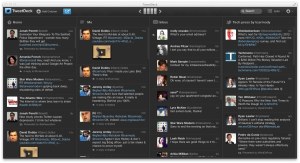
This way, you can manage all of your favorite twitter accounts. For example, you can add all your favorite restaurants to your TweetDeck to see new specials and announcements all in one place. Apart from these tools, there are many other useful tools that can be used when searching the web.


 

Virtual Reality/Augmented Reality Post

This week in class, we talked about virtual and augmented reality. Before this class I knew what virtual reality was, but never really had a clear idea of what augmented reality was. Both virtual and augmented reality are being used to impact the future of the food industry. Virtual reality (VR) is a simulated real-world environment, augmented reality (AR) remains in the real world and uses a variety of hardware devices and extensions to give users a layered or multidimensional view of an object.

The main areas that are affected by VR and AR in the food industry are designed to reduce the costs of training and to enhance the customer experience. When looking at reducing the cost of training, Simulating the training with VR creates an excellent simulated but noticeably unrealistic environment. When using this type of training the chefs can then visualize the process and the details looking at a single screen, requiring only one video to instruct any number of chefs. When using VR and AR on the marketing end for the food industry, in order to get customers to come to your restaurant, it requires creating a visual experience using VR and AR that is memorable and motivational to the consumer. Here are two examples of Coca Cola using VR and AR in their marketing campaigns.

We can see that VR is an experience, AR is an immersive experience and more interactive for the customer. AR has extended itself into connecting the physical world with the virtual world. This shows us a whole new world for marketing speaking in terms with connecting with the customer. In this example, companies are making video games available to customers on their cereal boxes.

Today and moving forward, technology is going to be enhancing our overall experience as a customer. For example, tequila manufacturer Patron has already taken this bold step. The company recently launched a 360-degree video showing the entire tequila manufacturing process, from harvesting the agave plant to bottling the drink. Sure, pictures and videos are fine when it comes to choosing where you want to eat, but AR is so much better.


Social Media Post

This week, we discussed social media. Social media is something we are surrounded by all the time in our everyday lives. Especially us millennials, everything is documented through social media. This can be a good and bad thing. When it comes to food, I always go to Instagram to get inspiration on meals to make or even when choosing where to go to eat. For example, tonight me and my roommates went to Monster sushi. When simply just looking at the menu, we had trouble deciding what to order. Instantly we all pulled out our phones to search “Monster sushi” on Instagram. There are a couple ways you can use Instagram when searching for food. First, would be looking at what people have posted under the tagged location. This is where you are going to find most of the photos of different foods the restaurant you are eating at is offering. I always do this because sometimes when just looking at the menu you can’t really get a feel for what the meal is going to taste like. That is why some food places add photos on their menu of their most popular dishes because more people are willing to order something that has a photo of it looking yummy. The next way you can use Instagram when searching for restaurants is simply finding their company Instagram page. This is where you are going to see all their best sellers because you are getting information from the actual source. However, using the location tactic when searching for food is going to give you more of a real answer, because it is customers posting.

Instagram isn’t the only social media we can use when looking at food. Facebook is another great way restaurants advertise their food. For example, when out to eat you can use Facebook to “check in” to show all your friends where you are eating. By checking in other people can do research on where you are out to eat. Facebook also allows you to read reviews on different restaurants to see if they are worth going to or not. Other than going out to eat, Facebook is always posting videos on different recipes to make. For example, I am obsessed with watching the “Tasty” videos that pop up on my Facebook feed and always save them so I can make them on my own!

Have you ever seen someone post a snapchat or even an Instagram story of food and you wonder where they are eating? In my opinion, social media is a great way for restaurants to be advertised due to the fact we can check in and show people where you are eating. That way there’s no need to wonder where that burger came from because we can use social media to advertise where, and what we are eating.

Good article on social media marketing


Practice post

Add text (You can copy any text from anywhere)

Multimedia TEST in Blog

* Adding a single image

* Add a hyperlink in your text https://moodle.ceaclassroom.com/course/view.php?id=772

* Adding a gallery + Adding a slideshow

This slideshow requires JavaScript.

* Adding a video from Youtube (2 ways) 

* Adding an audio from Soundcloud

* Adding a tweet

* Adding an instagram

Adding a visualization: